Latest News

Recent publications
Research projects



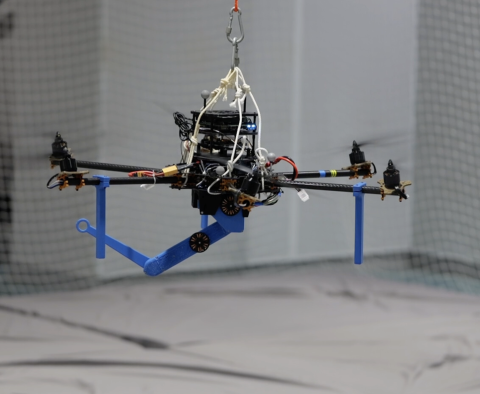
Hybrid AI Architectures for Complex Aerial Manipulation
Type of position:
PhD
Short abstract:
This PhD thesis will develop hybrid control architectures for aerial manipulation, combining model-based control and learning-based methods to enable reliable physical interaction with the environment. The project will investigate how predictive control, reinforcement learning, and multimodal sensing can be integrated to improve stability, precision, robustness, and adaptability during complex contact-rich manipulation tasks. The proposed methods will be validated in simulation and on real aerial robotic platforms.
Description:
Socio-Economic and Scientific Context
Aerial robots have reached a high level of maturity for perception and navigation tasks; however, their ability to perform physical interaction and manipulation remains limited [1]. Aerial manipulation involves strongly coupled dynamics between the flying platform, the manipulator, and the environment, leading to significant challenges in stability, precision, and robustness. From a scientific standpoint, model-based control approaches such as optimal and predictive control provide principled frameworks with stability and constraint-handling guarantees, but their performance degrades in the presence of modeling errors and unstructured contacts [3,4]. Conversely, learning-based methods, particularly reinforcement learning, enable adaptive and dexterous behaviors but suffer from limited interpretability, safety guarantees, and data efficiency [2]. Bridging these paradigms is a key open challenge for enabling reliable and versatile aerial manipulation.
Hypotheses and Research Questions
The central hypothesis of this project is that hybrid control architectures combining physics-based models and learning-based components can overcome the intrinsic limitations of each paradigm when considered in isolation. The project addresses the following research questions:
1) How can predictive control architectures be designed to integrate learning while preserving stability and constraint satisfaction during aerial physical interaction?
2) How can such hybrid architectures enable complex and dexterous aerial manipulation, involving prolonged, multiple, or dynamic contacts?
3) How can visual and tactile sensing be coherently integrated into the control loop to handle uncertainty and partial observability during interaction?
Envisaged Activities:
Thesis Structure and Research Plan
The thesis will proceed in four main stages. First, the dynamics of aerial manipulators in contact-rich scenarios will be analyzed, and baseline model-based controllers will developed and evaluated. Second, learning-based control policies for aerial manipulation will be designed and trained in simulation, with a focus on data efficiency and generalization. Third, hybrid control architectures combining model-based and learning-based components will be proposed and analyzed both theoretically and experimentally. Finally, the proposed methods will be validated on real aerial manipulation platforms, with a systematic evaluation of performance, robustness, and safety.
Methodological and Technical Approaches
The project will investigate bidirectional interactions between optimal control and reinforcement learning. This includes teacher–student schemes in which model predictive controllers guide policy learning through imitation or constrained reinforcement learning, as well as complementary approaches where learned policies provide informed initializations or motion priors for online optimization. Particular emphasis will be placed on sensor-based control, combining onboard vision with force or tactile feedback to close the control loop during physical interaction. The proposed approaches will be implemented and validated on aerial manipulators equipped with compliant actuation and force sensing, enabling the study of hybrid control strategies under realistic interaction conditions.
Conditions:
- The Ph.D. position is full-time for 3 years (standard duration in France). The position will be paid according to the French salary regulations for PhD students.
- We do high quality and impactful research in robotics, publishing on the major journals and conferences.
- We often collaborate with other top researchers in europe and worldwide.
- You will have access to a well established laboratory including:
- two flying arenas equipped with motion tracking system, several quadrotors, and a few fully-actuated manipulators,
- one robotic manipulation lab equipped with several robotic arms, like the Franka Emika Panda.
- You will be part of an international and friendly team. We organize several events, from after works, to multi-day lab retreat.
- Regular visits and talks by internationally known researchers from top research labs.
Requirements:
- M.Sc. degree in mechatronics, robotics, engineering, computer science (or related fields)
- Excellent written and spoken English skills
- Good experience in C/C++ , ROS, Matlab/Simulink, CAD
- Good experience with numerical trajectory optimization tools for robotics (e.g., use of CaSaDi, Acado, Autodiff, Crocoddyl, etc.)
- Scientific curiosity, large autonomy and ability to work independently
- Experience with robotic systems and/or aerial robots is a plus
How to apply:
Interested candidates are requested to apply via this form. The position will remain open until a satisfactory candidate is found.
In case of positive feedback, you will be contacted. If not positive, you won't hear back.
Applications sent directly by email and not through the web form will not be considered!!
Supervisors :
Dr. Marco Tognon